Pharmacies
Customer Loyalty for Pharmacies: Win Regulars — Without Your Own App
Customer loyalty for pharmacies: ideas, current figures from Austria and a digital loyalty program in Apple & Google Wallet — without a pharmacy-branded app.
Austria's pharmacies have something many local businesses have to build from scratch: proximity, trust and high daily footfall. Up to 600,000 people visit an Austrian pharmacy on an average day, and 95 percent of the population can reach the nearest pharmacy within ten minutes — those are the performance figures published by the Austrian Chamber of Pharmacists.
But a visit doesn't make a regular. In dermocosmetics, skincare and wellness in particular, the local pharmacy competes with mail order, drugstores and large platforms. In a pharmacy, customer loyalty therefore doesn't mean selling more medicine. It means extending advice and trust far enough that the next relevant purchase brings people back to this specific pharmacy.
A digital loyalty card in Apple Wallet and Google Wallet can help with exactly that — with no paper card and no pharmacy-branded app.
Why customer loyalty matters for pharmacies right now
Pharmacy coverage in Austria is dense, but the economics are demanding. According to the statistics of the Austrian Chamber of Pharmacists, the margin on proprietary medicinal products in the health-insurance segment fell from 15.4 percent in 2016 to 11.4 percent in 2025 — a drop of roughly 26 percent.
At the same time digital competition keeps growing. The Austrian Retail Association lists Shop-Apotheke.at in its 2025 top web shop ranking with revenue of EUR 199 million. The answer for a local pharmacy isn't to copy online retail at any price. Its strengths are personal advice, immediate availability and local proximity.
A loyalty program should extend exactly those strengths:
- It gives one more reason for the next visit.
- It keeps the pharmacy visible after the customer has left the store.
- It makes repeat visits measurable without building a medical profile.
- It rewards voluntary purchases in a clearly defined non-medicinal range.
What customers no longer want
A plastic card is extra baggage. A paper punch card gets lost or stays at home. And a dedicated app demands a download, registration, permissions and updates — a high hurdle for a simple loyalty program.
So the better question isn't "how do we get one more app onto the phone?" but "how do we put the loyalty card where digital cards are already expected?" That is exactly what a loyalty card in Apple Wallet and Google Wallet does: it sits between the bank card and the boarding pass, not in a purse.
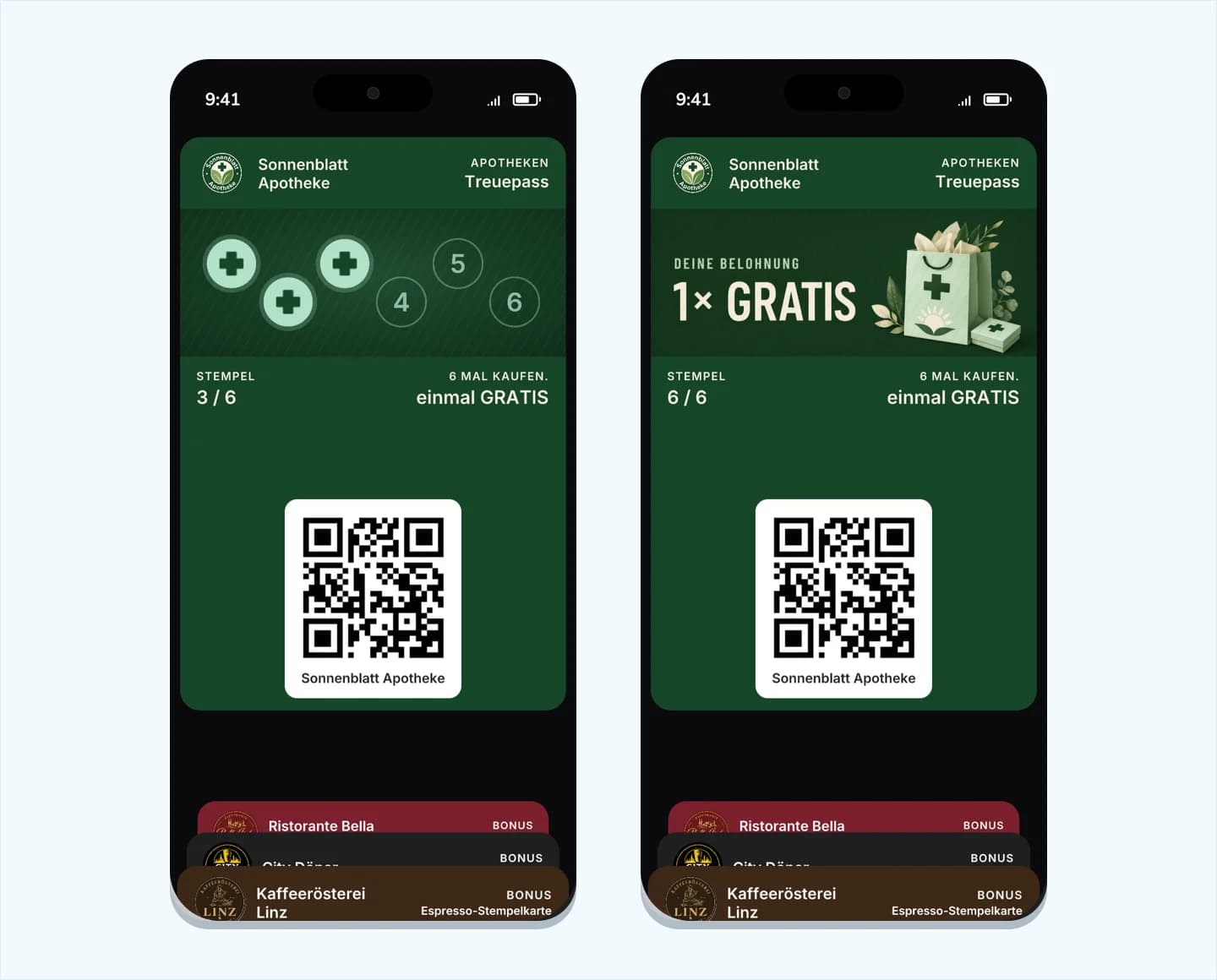
With reloop, the customer scans a QR code and saves the card straight into their wallet. At the next qualifying purchase they show the QR code on the card, the pharmacy team scans it in the staff interface, and the new stamp appears on the card. The mechanics of a digital stamp card without your own app are covered in detail in its own article.
No extra customer app. No plastic card. No ink pad.
How a digital loyalty card works for pharmacies
1. Define the program clearly
The pharmacy decides which non-medicinal products or non-medical services earn a stamp, how many stamps are needed and what reward waits at the end. The rules must be understandable at the counter and in the terms of participation without follow-up questions.
2. Put the QR code where the decision happens
The program QR code belongs on a well-made counter display, in the consultation area, on the receipt or on a flyer. One sentence is enough:
"Our loyalty card now lives on your phone — no separate app required."
3. Save the card in the wallet
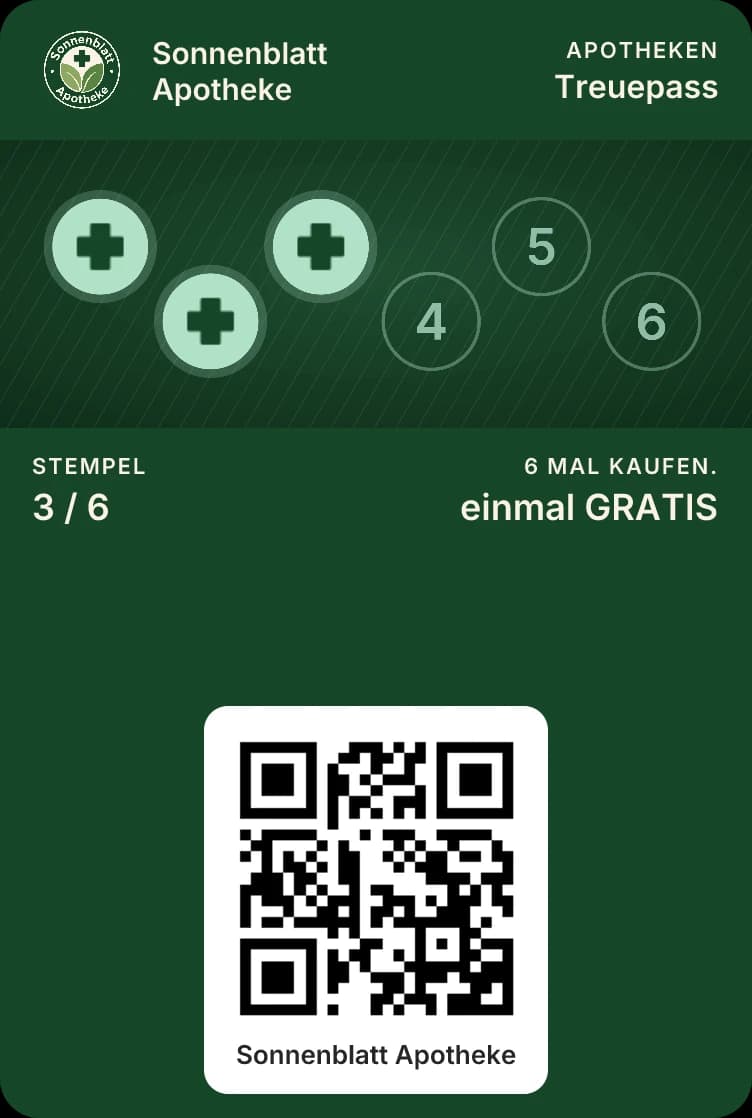
After the scan, the customer picks Apple Wallet or Google Wallet. The card carries the pharmacy's logo, colours and name. A data-minimal stamp program needs no lengthy registration.
4. Let the team issue the stamps
Only authorised staff issue stamps. Every action is tied to a staff account and traceable in the log; cooldowns and time-limited QR codes prevent duplicate stamps. More on that in the article about protection against self-stamping and shared QR codes.
5. Make the reward visible and measure repeat visits
Progress updates directly on the wallet card. Once the goal is reached, the reward becomes visible. How many cards are active, how many stamps were issued and how many rewards were redeemed is shown in the reporting and customer overview in the reloop dashboard.
Which loyalty models suit a pharmacy
A pharmacy program should not encourage the consumption of medicine. What works are simple programs for clearly delimited non-medicinal ranges.
| Area of use | Example mechanic | Possible reward |
|---|---|---|
| Dermocosmetics and skincare | One stamp per qualifying purchase | Travel-size care product |
| Body, mouth and dental care | Five qualifying purchases | Small item from the non-medicinal range |
| Wellness and selected supplements | One stamp per purchase above a transparently defined minimum | Benefit on a later qualifying purchase |
| Seasonal care | Campaign card for sun, winter or travel care | Themed non-medical reward |
| Consultation events | Attending clearly defined, permissible event days | Bonus stamp or non-medical item |
The reward should be attractive without being pushy. Most importantly: state clearly in the terms of participation which product groups take part — and that medicines plus any legally or contractually excluded products are not included.
In practice: the pharmacy loyalty pass

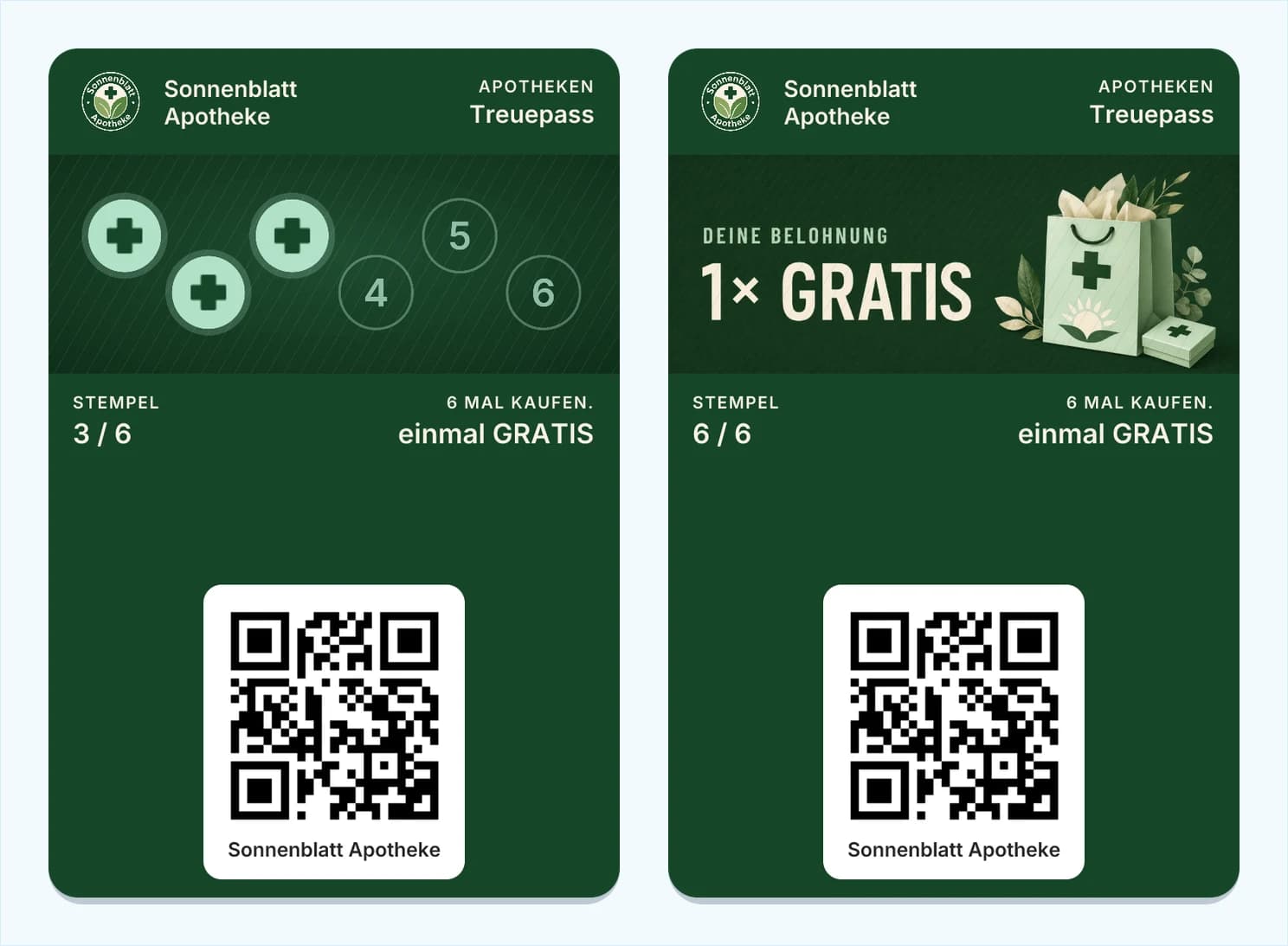
For this article we set up a complete demo program — Sonnenblatt Apotheke is a fictional sample business, but the card itself is real and comes straight out of the renderer.
- Demo pharmacy: Sonnenblatt Apotheke (fictional sample business)
- Program: Apotheken Treuepass (pharmacy loyalty pass)
- Mechanic: 6 qualifying purchases, then 1× free
- Scope: only clearly defined, participating non-medicinal products
A possible sequence:
- A customer buys a qualifying dermocosmetics or skincare product.
- At the counter she scans the QR code once and saves the card to her wallet.
- The team scans the QR code on the wallet card and issues the first stamp.
- Every further qualifying purchase grows the visible progress.
- After the sixth stamp the card displays the reward: one item free.
- The team redeems the reward digitally; the action shows up in reporting.
The demo deliberately shows no medicine names, diagnoses or purchase histories. It only shows how easy participation is at the counter — and how professional the pharmacy looks inside the customer's wallet.

Staying visible after the visit — without a health profile
A wallet card is more than a digital replacement for paper. The pharmacy can push general, non-sensitive information through the card:
- a reminder about a reward that is still open,
- an announcement of dermocosmetics or skincare days,
- changed opening hours,
- a note about a seasonal focus in the non-medicinal range,
- double stamps on explicitly participating care products.
Communication must never be derived from a presumed health condition. "Your reward is still available" is something entirely different from a message that implies an illness, medication or diagnosis.
For the stamp program itself, only the data that is genuinely needed should be processed: card ID, stamp count, time and location of the stamping action, plus the technical security context. Product details, prescriptions, diagnoses or consultation content do not belong in a loyalty profile.
Data protection and pharmacy advertising: the guardrails
Pharmacies operate in a particularly sensitive environment. The implementation therefore has to be kept cleanly separated, both professionally and legally:
- No consumer advertising for prescription medicines. Section 51 (1) of the Austrian Medicinal Products Act generally rules out consumer advertising for prescription-only medicinal products.
- Price advertising for medicines is heavily restricted. The professional code of the Austrian Chamber of Pharmacists contains specific rules and only narrowly defined approved exceptions.
- Draw the loyalty mechanic conservatively. We recommend tying stamps and rewards exclusively to explicitly defined non-medicinal ranges or permissible non-medical services.
- Do not build health profiles. Health data enjoys special protection under Article 9 GDPR. Diagnoses, prescriptions, medicines or interests derived from them must not be linked to a loyalty account unnecessarily.
- Transparent information and clear purposes. Terms of participation and privacy notices must explain which data is processed for what. Newsletter or email marketing is handled separately and compliantly.
- Document processing properly. reloop hosts in the EU and provides a data processing agreement plus export and deletion processes — see security and data protection at reloop. The pharmacy remains responsible for configuration, legal bases and customer information.
Paper card, own app or wallet card?
| Paper card | Own pharmacy app | reloop wallet card |
|---|---|---|
| Can get lost | Has to be installed and maintained | Lives in Apple or Google Wallet |
| No reliable reporting | High technical and organisational effort | Stamps and redemptions visible in the dashboard |
| Easy to pass on or back-stamp | Needs its own login and security logic | Staff scan, signed QR mechanic and audit log |
| No digital updates | Push infrastructure must be built | General wallet updates and campaigns possible |
| Printing and reordering effort | App store releases and updates | Configurable in a few minutes |
A dedicated app can make sense when a pharmacy chain wants to build a full digital ecosystem with a shop, services and medication management. For a clearly delimited loyalty program it is usually bigger than the problem. The wallet card focuses on the simple core: save, show, collect, come back.
How a pharmacy starts: a 30-day pilot
Instead of mapping the entire range at once, a small, measurable pilot works better. The detailed launch plan for the first 30 days walks through every week — here is the pharmacy version:
Week 1: program and guardrails
- Pick one clearly delimited non-medicinal category.
- Define reward, stamp goal, exclusions and terms of participation.
- Design the card with logo, colours and reward artwork.
- Have privacy and ad copy reviewed internally.
Week 2: team and point of sale
- Train staff on a short, fixed sequence.
- Place a well-made QR display at the counter.
- Agree on one standard introduction sentence.
- Rehearse test stamps, redemptions and edge cases.
Week 3: activation
- Offer the program actively and warmly on matching purchases.
- Never force participation and never mix advice with the bonus.
- Watch where questions or drop-offs occur.
Week 4: evaluation
- Compare newly saved cards against active cards.
- Look at the ratio of stamps to redemptions.
- Review return intervals and team feedback.
- Adjust reward or wording only based on real usage.
Frequently asked questions
Are pharmacies allowed to run a loyalty program? In principle, yes. Because of the specific advertising, pricing and data protection rules in healthcare, the concrete mechanic has to be reviewed properly. This article recommends limiting stamps and rewards clearly to defined non-medicinal ranges or permissible non-medical services.
Which products should a pharmacy stamp card cover? Clearly defined non-medicinal areas such as dermocosmetics, body care or wellness products work best. Medicines, prescriptions, diagnoses and legally or contractually excluded products should not be part of the loyalty mechanic.
Do customers have to install an app? No pharmacy-branded app. The QR code leads to the digital loyalty card, which is saved in Apple Wallet or Google Wallet. From then on it opens like any other digital card on the phone.
How is a stamp issued? The customer shows the QR code on the wallet card. An authorised team member scans it in the reloop staff interface. The new stamp becomes visible on the card and is logged in the system.
What data does a digital stamp card need? A data-minimal program needs no diagnosis, no prescription and no medication history. The technical flow essentially requires the card ID, the stamp count and the information needed for a secure stamping action. Optional channels such as email are implemented separately and transparently.
Does the loyalty card work on iPhone and Android? Yes. reloop issues cards for Apple Wallet on the iPhone and Google Wallet on supported Android devices. The pharmacy manages both variants centrally from the same program.
Conclusion: extending the local pharmacy's strength digitally
Austria's pharmacies don't need to reinvent proximity and trust. They only need to make sure those strengths stay visible between two visits. A good loyalty program rewards neither illness nor medicine consumption — it creates a clear, voluntary incentive to return around suitable ranges.
With reloop the digital loyalty card lands straight in Apple Wallet or Google Wallet. The team stamps by scan, the reward stays visible, and the dashboard shows whether the program is actually being used. That is how high footfall turns into lasting customer loyalty — credible, measurable and a fit for the pharmacy on the corner.
Sources and method
- Austrian Chamber of Pharmacists, performance figures — daily visits, accessibility, number of pharmacies.
- Austrian Chamber of Pharmacists, statistics (as of Dec 31, 2025) — 1,445 public pharmacies, 28 branch pharmacies, margin in the insurance segment.
- Austrian Retail Association, top web shop ranking 2025 — ranking value for Shop-Apotheke.at, not an official financial statement.
- RIS, Medicinal Products Act, Section 51 — consumer advertising for prescription-only medicinal products.
- Austrian Chamber of Pharmacists, resolution of the delegates' assembly of June 24, 2021 — price advertising for medicines.
- EUR-Lex, General Data Protection Regulation — data minimisation (Art. 5) and health data (Art. 9).